
It’s a cold October night on Kelley’s Island in Lake Erie; something magical is about to happen.
Tom Bartlett reaches into a mist net and gently lifts out a bird that weighs about as much as a few AA batteries. It has enormous yellow eyes, a face like a startled teddy bear, and absolutely no idea it’s about to become a data point.
Tom Bartlett is a master at his craft, which includes bird banding, breeding-bird studies, wildlife surveys, population monitoring, taxonomy,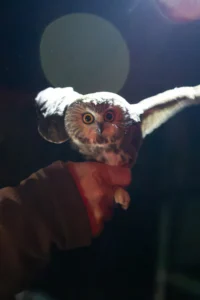 and long-term baseline wildlife research at Springville Marsh State Nature Preserve, the Lake Erie islands, and other important natural areas across Ohio. The bird on this particular night is the Northern Saw-whet Owl, and it’s one of the best-kept secrets of the fall migration.
Saw-whets are tiny, nocturnal, and so good at hiding that for years scientists assumed most of them stayed put all winter. Then banders began setting up nets at night, playing a recording of the owl’s soft, tooting call. The owls came in numbers nobody expected. It turned out that thousands were quietly flying south under cover of darkness, right over our heads.
That discovery is a reminder of how much of nature happens without us noticing. Because these owls are so small and secretive, we can’t count them the way we count hawks from a ridge. Bird Banding, in which each bird is weighed, measured, fitted with a tiny, numbered band, and released within minutes, is how researchers piece together where they go, when they travel, and whether their numbers are holding steady.
The owls face the same pressures many wildlife species do: loss of forest habitat, collisions with cars and windows, and rodent poisons that travel up the food chain. A saw-whet that eats a poisoned mouse can be poisoned too.
What you can do?
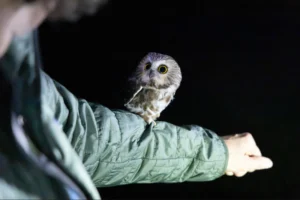
This little guy made a friend
- Skip rodenticides and try traps or prevention instead
- Make windows more visible to birds
- Keep a respectful distance if you ever find a roosting owl, and never share its location publicly
- Support local banding stations and bird observatories, many of which welcome visitors and volunteers
The next time you step outside on an autumn night, listen. Somewhere out there, a bird the size of your fist might be on a journey of hundreds of miles.
How Do You Tell How Old an Owl Is? Ask a Flashlight.
Picture a bander on a cold November night holding an owl no bigger than a coffee mug. How do you tell how old a bird like that is, or whether it’s male or female? The owl isn’t talking, and its feathers give almost nothing away to the naked eye. The answer is a small ultraviolet flashlight and a ruler.
The glow that gives away an age
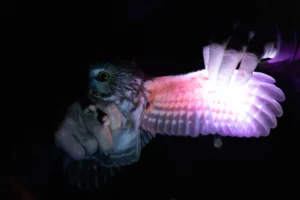
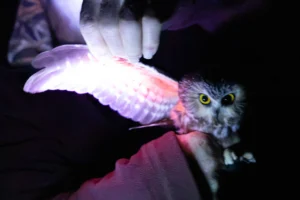
When the bander shines a UV (black) light on the underside of a saw-whet’s wing, some feathers glow a vivid pink. The glow comes from natural pigments called porphyrins, which are present in newly grown feathers and fade as feathers age and wear. Fresh feathers shine. Old ones go dull.
That fading is what makes the trick work:
- A bird hatched this year grew all its flight feathers at the same time, so the whole wing glows evenly pink.
- An older bird has a patchwork wing. Feathers it replaced recently glow brightly beside older, faded ones, and that mix of generations is the giveaway. Banders can sometimes even tell a two-year-old from an older owl by the pattern.
This matters more than you might think. By November, young saw-whets have molted into plumage that looks much like an adult’s, so the UV check is often the clearest way to separate this year’s owls from veterans. Banders also consider feather wear and shape, but the glow does much of the work.
The ruler and the scale
Telling males from females is harder. Saw-whets don’t differ in plumage, so banders rely on size, and females are noticeably larger. They measure the length of the folded wing and weigh the bird. Females generally have longer wings and weigh more, and males run smaller.
The catch is that the ranges overlap. A big male and a small female can look nearly identical on paper, and a bird’s weight can swing depending on when it last ate. Banders often combine several measurements to make a call, and when a bird falls in the gray zone, an honest “unknown” goes in the record. A guess would only add error to data that scientists will use for years.
Why this matters for conservation
These details add up to something much bigger than one owl. Because saw-whets are tiny, nocturnal, and secretive, banding is one of the few ways to learn how they’re doing. Counting young birds shows whether a breeding season went well. Counting females versus males shows who is migrating and how far. Over decades, those numbers reveal whether populations are steady, growing, or quietly shrinking.
Interestingly, females tend to dominate the fall flight, since they travel farther than males, and many of the owls passing through are young birds on their very first journey south.
So, the next time you picture an owl in the night sky, remember that a few ounces of feathers, a pink glow, and a patient person with a flashlight are helping us understand a bird we would otherwise rarely see.
One owl, one night, one first migration. A hatch-year Northern Saw-whet Owl is banded on Kelleys Island in November, its wing glowing pink under UV light before it’s released to continue south.
Under ultraviolet light, the underside of the wing glows pink. Fresh feathers fluoresce, and that glow helps banders tell a young owl from an older one. The wing’s even glow told the bander this owl was a first-year bird, hatched this past spring and now on its first migration south. Its sex couldn’t be determined, which is common with saw-whets.
Cheers,
Dave
Related Posts


Stay Connected
Join my collector’s list to receive updates on new releases, exhibition openings, and behind-the-scenes stories.