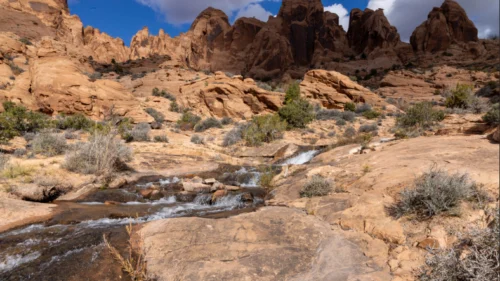
A Mountain Stream in the Abajo-Fed High Country
Canyonlands is better known for its desert, but its wetter edges tell a different story. In the park's northern reaches and along the flanks of the nearby La Sal Mountains, whose snowmelt feeds countless small drainages in the region, a nameless stream threads through a cooler, greener world. It has no marker, no trail sign, and no one to call it anything but the creek.
Headwaters
It begins as a seep, a dark stain on a shaded rock face where water beads and drips onto moss. Below the seep, the drips gather into a trickle that finds a crack, then a shallow groove, then a channel the width of a boot. In late spring, snowmelt swells it considerably, and the stream becomes loud, tumbling over tilted slabs of sandstone and dropping into small, bowl-shaped pools scoured smooth by years of current.
At this elevation the air feels different. It is thinner, cooler, and scented with ponderosa pine and damp earth. The morning light arrives late, filtered through branches, and the stream stays in shadow long after the rim above has turned gold.
The Water
The water is remarkably clear. Over its sandy and pebbled bed you can count the grains, the flecks of mica, and the delicate shadows of the current. In the pools, it turns a deep green-blue, and in the riffles it breaks into white threads that hiss and chatter. Small cascades step down the slope, each one a miniature waterfall that spills into a basin before moving on.
Cold is the defining quality. Even in midsummer, the stream holds the chill of the snowpack that fed it, and a hand dipped in aches within seconds. Mist sometimes gathers over the pools in the early morning, drifting upward as the sun finally reaches the canyon floor.
Plants and Animals
Along the banks, a lush corridor grows. Box elder and narrowleaf cottonwood arch overhead, joined by thickets of willow and red-osier dogwood whose stems glow crimson in the cooler months. Ferns and columbine cling to the wet rock, and monkeyflower brightens the edges with spots of yellow. Moss carpets the stones below the small falls, vivid green against the red rock.
Life gathers here. American dippers, plump gray birds that bob on the rocks, plunge into the current to hunt insect larvae, and their bright song rises above the sound of the water. Tiny trout hold in the deeper pools, flicking out of sight when a shadow passes. Mule deer step down at dusk, black bears occasionally pass through in search of berries, and along the muddy margins, the tracks of raccoons and ringtails crisscross like handwriting.
Overhead, Steller's jays scold from the pines, and swallows stitch the air above the pools, catching insects in quick, looping flights.
Where the Mountain Meets the Desert
Follow the stream downhill and the transformation is striking. The pines thin out, replaced by pinyon and juniper. The banks widen and dry. The water slows, spreads, and sinks into sandy gravel, shrinking with each bend. A few hundred yards on, the channel is nothing but a ribbon of damp sand, and then simply dust and stone.
Few people will ever follow this stream from beginning to end. Its descent takes it through a series of small, hidden places: a shaded alcove where water drips from an overhang into a fern-lined pool, a narrow chute where it slides over red stone, a quiet bend where the light falls in long golden bars.
A Quiet Lesson
What makes an unnamed stream special is its anonymity. It exists without an audience, shaping the rock, feeding the plants, and sustaining the animals that depend on it, whether anyone notices or not. Sitting beside it, listening to the water move over stone and watching the light shift through the leaves, you can sense something older and steadier than any map or name.
By the time it vanishes into the desert floor, the stream has done what it always does: carried a little of the mountain downward, and given life to everything it touched along the way.