
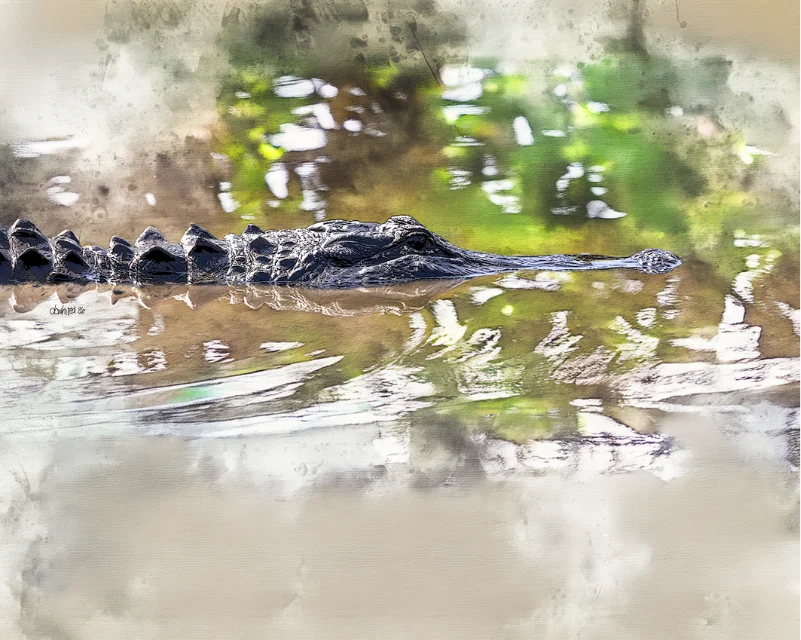
The American alligator (Alligator mississippiensis) is one of the largest reptiles in North America and a conservation success story.
Appearance: Adults are dark gray to nearly black, with a broad, rounded, U-shaped snout, a feature that helps distinguish them from the narrower, V-shaped snout of crocodiles. Males typically reach 11 to 15 feet and can weigh 500 pounds or more, while females are smaller, usually topping out around 10 feet. The largest reliably measured individuals have exceeded 14 feet, and an unverified Louisiana record claims more than 19. Hatchlings are black with bright yellow bands that fade as they mature. Alligators can live 30 to 50 years in the wild.
Range and habitat: Alligators live across the southeastern United States, from North Carolina through Florida and west to eastern Texas, with Louisiana and Florida holding the largest populations. They favor freshwater habitats such as swamps, marshes, rivers, lakes, and ponds, though they can tolerate brackish water for short periods. In cooler months they become sluggish and enter a dormant state called brumation, and they have been seen surviving ice by keeping their snouts above the surface.
Diet and hunting: Alligators are opportunistic predators. Young ones eat insects, snails, crustaceans, and small fish, while adults take larger fish, turtles, snakes, birds, and mammals ranging from rodents to deer. They typically ambush prey, lunging from the water’s edge or striking from below. Their bite is among the strongest of any living animal, strong enough to crush turtle shells.
Reproduction and family life: Breeding takes place in spring. Males attract mates with deep bellows that make the water visibly shimmer, a display sometimes called a “water dance.” Females build mound nests from vegetation, lay 30 to 50 eggs, and guard them through roughly two months of incubation. Nest temperature determines the sex of the offspring, with warmer temperatures producing males and cooler ones producing females. When the hatchlings begin peeping from inside their eggs, the mother helps excavate the nest and may carry them to the water in her mouth. She often protects them for a year or more.
Ecological role: Alligators are considered a keystone species. They dig depressions known as “gator holes,” which hold water through droughts and give fish, turtles, birds, and other animals a refuge. Their nest mounds also provide habitat for other species, and their predation helps keep prey populations in balance. In places like the Florida Everglades, the ecosystem would look very different without them.
Conservation: Hunting and habitat loss drove alligators toward extinction in the mid-20th century, and they were listed as endangered in 1967. Protection and regulated management brought them back, and they were declared recovered in 1987. Today the population is estimated at several million, and the IUCN lists the species as Least Concern. They remain federally protected as “threatened due to similarity of appearance” to the American crocodile, which is still endangered in parts of its range, and regulated hunting continues in several states.
Living alongside people: Alligator attacks are rare but do occur, usually near water in warm months and often involving people who have fed them. Feeding is illegal in many states because alligators that lose their fear of humans become dangerous and are often destroyed. Keeping a safe distance, avoiding swimming at dusk or dawn in alligator habitat, and keeping pets away from the water’s edge are the best precautions.
Gators of the Glades
Nowhere is the alligator’s role as an ecosystem engineer easier to see than in the Everglades. During the dry season, when the “river of grass” shrinks to a few pools, alligators dig and maintain gator holes that hold water when everything around them dries up. Fish, turtles, wading birds, and even otters crowd in, which makes these holes lifelines for the whole food web. Pair that with the Everglades being the only place on Earth where alligators and American crocodiles share habitat, and you have one of the most remarkable reptile landscapes in the world. The best viewing is usually December through April, when the dry season concentrates wildlife around the remaining water, and spots like Anhinga Trail and Shark Valley are reliable places to see them from a safe distance.
Shipping is included in the listed price.
Reviews
There are no reviews yet.