
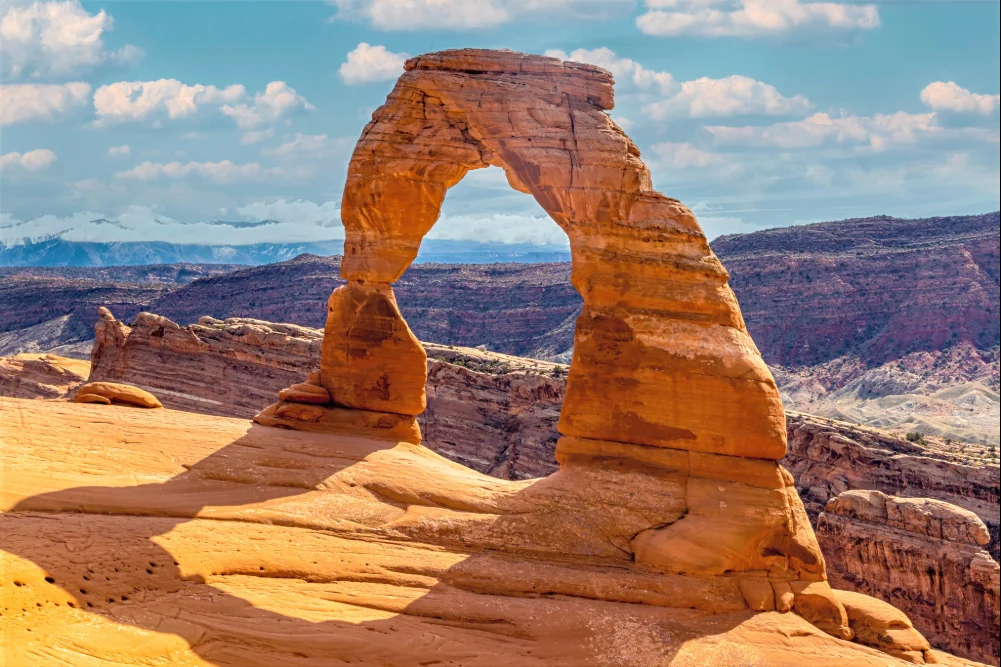
Delicate Arch is a freestanding sandstone arch in Arches National Park, near Moab in southeastern Utah. It stands about 52 feet (16 meters) tall and is widely considered the most recognizable natural landmark in the state. Its image appears on Utah license plates, and it has become a symbol of the American Southwest.
Geology and formation
The arch is carved from Entrada Sandstone, a rock layer that formed roughly 150 million years ago from sand dunes and sediments deposited in a vast desert environment. Over millions of years, the region was buried, compressed, and then uplifted. Underground salt beds below the sandstone shifted and collapsed, which caused the overlying rock to crack into long vertical fins. Water seeping into those cracks, freezing in winter and thawing in summer, gradually wore away the weaker rock. Wind and erosion did the rest, leaving behind the graceful curve people see today. Arches National Park contains more than 2,000 documented natural arches, the highest concentration in the world, but Delicate Arch is the one that captures the public imagination.
Unlike many arches that sit within a rock wall, Delicate Arch stands alone on the edge of a large sandstone bowl, which gives it a dramatic and almost sculptural presence. Its two legs are uneven, and the opening frames the distant La Sal Mountains, which are often capped with snow well into spring. Like all arches, it is temporary on a geological timescale. Erosion continues to shape it, and one day it will collapse, as other arches in the park have done.
History and name
The Ute people lived in the region long before European settlers arrived, and the area holds cultural importance for several Native American communities. Mormon settlers and ranchers passed through in the nineteenth century. The arch is said to have been known informally by names such as “Landscape Arch” and “the Chaps” before its current name stuck. Delicate Arch received its lasting title because of its slender, refined shape. The surrounding area was first protected as a national monument in 1929 and became a national park in 1971.
Visiting the arch
Seeing Delicate Arch up close requires effort. The main trail is about 3 miles (4.8 km) round trip and climbs roughly 480 feet. It begins at the Wolfe Ranch trailhead, where visitors can see a historic cabin, then crosses a footbridge and heads up a long, exposed slab of slickrock. The final stretch follows a narrow ledge before the trail opens suddenly into the natural amphitheater, revealing the arch in full. The hike has little shade, so summer heat can be intense, and visitors are urged to bring plenty of water, wear sturdy shoes, and start early.
For those who cannot manage the hike, there are two viewpoints. The Lower Viewpoint is a short, easy walk, while the Upper Viewpoint requires a steeper climb. Both show the arch from a distance, but neither matches the experience of standing beneath it.
Photography and atmosphere
Delicate Arch is famous for sunset, when the sandstone glows in deep shades of orange and red against the evening sky. This is also when the trail is most crowded, so patience is useful. Sunrise offers softer light and fewer people, and a clear night can reveal an astonishing sky full of stars. Visitors should stay off the arch itself and avoid walking beneath it in ways that damage the fragile surroundings.
Why it matters
Delicate Arch is more than a pretty rock formation. It reflects the slow, powerful forces that shape the planet and reminds us how fleeting even the most enduring landmarks can be. For many visitors, the effort of reaching it makes the reward feel earned, and that sense of discovery is a large part of its enduring appeal.
Check the National Park Service website before you go for current entry requirements, timed-entry reservations (which have applied during peak seasons), and trail conditions.
Reviews
There are no reviews yet.