
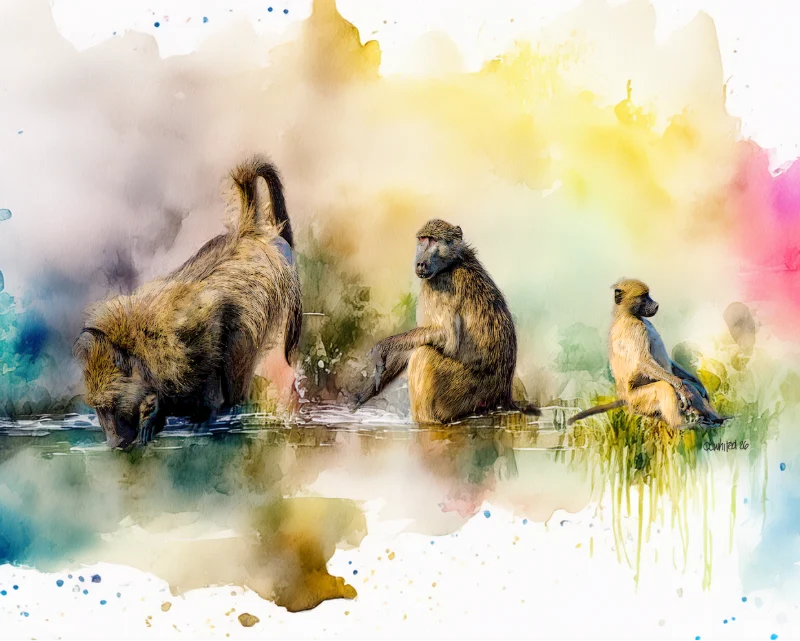
The chacma baboon (Papio ursinus) is the largest of the baboon species and one of the most familiar wild primates in southern Africa.
Appearance: Chacma baboons have a dark, coarse coat that ranges from brownish-gray to nearly black, with a long, dog-like muzzle, a prominent brow, and close-set eyes. Males are much larger than females, often weighing 30 to 40 kg (66 to 88 lb) against 15 to 20 kg for females, and they have impressive canines. Both sexes have bare, calloused sitting pads, and females develop dramatic swelling when fertile.
Range and habitat: They live across South Africa and neighboring countries, including Namibia, Botswana, Zimbabwe, Mozambique, Lesotho, and Angola. They are highly adaptable and thrive in savanna, woodland, mountains, semi-desert, and coastal areas. The Cape Peninsula population is especially well known, and troops there forage on the shore for mussels and other seafood.
Diet: Chacmas are omnivores. They eat fruits, seeds, grasses, roots, and flowers, along with insects, scorpions, eggs, and occasionally small vertebrates. Their flexibility is a major reason for their success, and it also leads them to raid crops, gardens, and even cars and houses.
Social life: Troops typically number 30 to 100 individuals and are organized around a female-based hierarchy. Females stay in the troop they were born in, and their rank is inherited, while males move between troops. Grooming is central to bonding and maintaining alliances. Chacmas communicate with a wide range of vocalizations, including the loud two-syllable “wahoo” bark of dominant males, along with facial expressions and body postures. Troops sleep in trees or on cliff ledges to avoid predators like leopards.
Conservation and human conflict: The species is not considered globally threatened, but local populations face real pressure. Habitat loss, road collisions, electrocution on power lines, and conflict over food in suburban areas are major problems. In places like Cape Town, authorities and conservation groups use baboon monitors, troop-management programs, and public education, and visitors are urged never to feed them, since food-conditioned baboons can become dangerous and are often euthanized.
Shipping is included in the listed price.


Reviews
There are no reviews yet.